It is the ultimate irony of our scriptures.
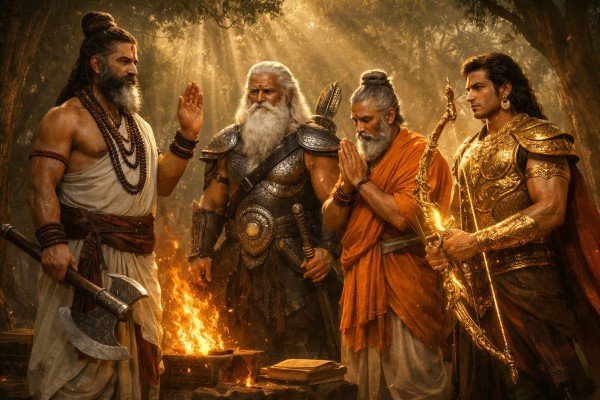
Imagine a war where the greatest obstacles to the divine will were created by the divine itself. We often speak of Lord Parshuram, the ferocious Avatar of Vishnu, the Guru of Gurus. He was the one who cleared the earth of tyranny twenty-one times. But as his era as a warrior faded and his role as a teacher began, he forged three distinct arrows that would one day threaten the very heart of Dharma.
Bhishma Pitamah, the man who could command death to wait.
Guru Dronachary, the vessel of all military science and divine weaponry.
Angaraj Karn, the warrior whose charity and skill rivaled the gods.
These were not villains. They were the gallant masterpieces of Bhagwan Parshuram. They carried his discipline, his weaponry, and his terrifying power. They were mighty enough to change the course of history, to rewrite wisdom, and to define the culture of Bharat.
And yet, they stood on the wrong side of the line.
This is where the story shifts from a mere battle to a profound lesson in leadership.
In the royal court of Hastinapur, a blindness had taken hold—and it wasn’t just the physical blindness of King Dhritarashtr. It was a blindness of conscience. The King’s bias toward his son, Duryodhan, had turned into a toxic rot that was eating the kingdom alive. Injustice had become the law.
The humiliation of a queen, the attempted murder of kin, the suffering of the common citizens—all of it was happening under the protection of Parshuram’s three greatest students. Bhishm was bound by a vow to the throne, Drona by his employment, and Karna by his debt of friendship.
Enter Shri Krushn
If Parshuram was the fire that burned the old forests, Krushn was the gardener who knew that sometimes, even the mightiest ancient trees must be uprooted to let the sunlight reach the saplings.
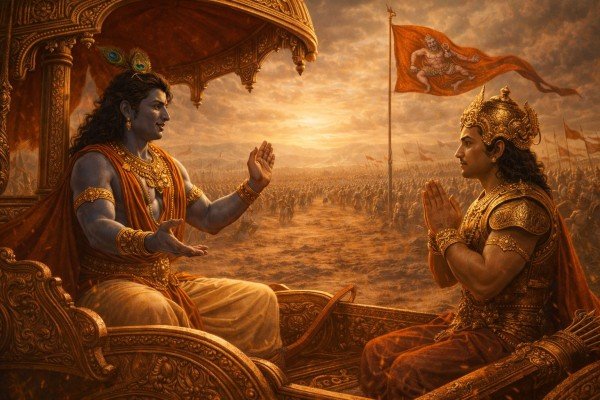
Krushn looked at the battlefield and saw the paradox. He saw that to save the future—to save the sustainable culture of Dharma—he had to dismantle the legacy of the past. He realized that "goodness" without the courage to act against injustice is meaningless.
This was the hardest test of leadership the world had ever seen. Krushn had to drive the Pandavas to do the unthinkable: to raise weapons against their own grandsire, their own teacher, their own brother. Why? Because the survival of a civilization mattered more than the survival of individual legends.
glanir bhavati bharata...
It culminated in that thundering promise on the battlefield. This is the essence of true transformation.
It is not a gentle process. It is not just about knowing what is good or bad. It is the terrifying, beautiful courage to look at something powerful, something established, something you perhaps even admire—and say, "This no longer serves the future. It must change."
Shri Krushn didn't just win a war; he reset the heartbeat of a civilization. He showed us that true leaders don't just manage the present; they protect the unborn future. They break the patterns of the past, even if it breaks their hearts, to ensure that Dharm rises again.
That is the story of Parshuram’s might, and Krushn’s vision. That is the story of us.